Sunday, July 22, 2012
Update: July 9-22
OK. I know I have not posted anything since July 9! We have been on a whirl-wind tour of places in three countries. Early starts, long days, lots of walking, late evenings--but I have been taking notes and pictures (of sites as well as food.) Unfortunately, some of the food pictures have not come out so well so I will just have to describe.
I could say that for the most part, the food has been . . . substantial!
Many of our breakfasts have been classical European style: in addition to cereals, there is yogurt (sometimes with fruit), fruit of various kinds, varieties sorts of wonderful cheeses, sausages, and breads and of course good coffee. Lunch, when we have had lunch, is often something at a sidewalk cafe. I'd like to say the "something" was always light, but many meals in this part of the world include potatoes and sausage. So, we have eaten a lot of those. Dinner is usually late. We have tried to eat as much "local" as possible, just for the experience. But in addition to Swiss, German, and Dutch, we have also tried Thai, Italian, Chinese, Indonesian, and Portuguese. In the big cities (especially Berlin and Amsterdam, these are local--you can find these just about everywhere you turn.)
Below is an itinerary of where we have been since I last posted:
July 11-12:
We were back in Zurich at Mike and Sarah's to do laundry and catch up. The way it works in their apartment is that you get assigned a couple of laundry days each month (about 2 weeks apart.) On your days you have exclusive access to the laundry facilities in the basement. You don't get to do laundry any other time. We took full advantage of these two days because we won't be back here until late on July 25 (which also means we will miss the next laundry day.) We have to have enough clothes to make it until the end of the month!
July 13:
Took the 3-hour train ride to Heidelberg, Germany. Wandered the old town that evening.
Stayed at the Mission Hotel.
July 14:
Spent the day exploring churches, the University, and the castle in Heidelberg. Discovered schneeballen (literally: snow balls. No, they are not those marshmallow/pink coconut things with the chocolate cake. They are huge, dense balls of dough with all sorts of wonderful centers and icing.)
July 15:
Up early for the 6-hour train ride to Torgau, Germany. The train went through Erfurt, Eisenach, and Wittenberg--all important towns in Luther's life. Stayed at the Hotel Central. Explored Torgau, looked for a church; visited the castle. Ate authentic German food for dinner at the cafe overlooking the castle grounds.
July 16:
Explored Torgau some more. Ducked into a coffee shop just before the rain came pouring down. (I love the European coffee shop culture--they are everywhere, easily accessed, and where people meet routinely.) Took an afternoon train to Berlin. Took a walk in the park after we settled in at the Sir Savigny hotel.
July 17:
Sites around Berlin: Brandenburg Gate, Reichstag, Checkpoint Charlie.
July 18:
Places in Berlin: Pergamon museum, Berliner Dom.
July 19:
Took a train back to Wittenberg. Spent the day there exploring the university, old town plaza, and the castle church. Back in Berlin for the night.
July 20:
Up early for the train to Münster, Germany. Only had the afternoon to find and read the Anabaptist story here. Visited several churches and the local museum as well as roamed around town.
July 21:
Rented a car here to drive to The Netherlands. A 2 1/2 hour drive to Pingjum and Witmarsum, charming little towns, the home of Menno Simons. Took a walk along the dike which holds out the North Sea from this very flat land. Continued to drive another hour to Amsterdam, to stay at the American Hotel. We are here for 4 days. Several places we want to visit.
July 22:
Ate Dutch waffles for breakfast. Visited the van Gogh museum. Learned some things about the artist--and was reminded that art is not always the answer to a trouble soul.
July 23:
Tomorrow we plan to go Corrie ten Boom's house in Haarlem and visit the Old Church in old Amsterdam.
More to come . . . the schedule from here is still under construction.
July 25:
Late Wednesday night we will fly back to Zurich. We will be there to catch up with ourselves, visit a few places we still want to see, and possibly eat some more.
I am posting some notes I have taken and related pictures. Hopefully, I will get caught up with this in the next day or two.
I could say that for the most part, the food has been . . . substantial!
Many of our breakfasts have been classical European style: in addition to cereals, there is yogurt (sometimes with fruit), fruit of various kinds, varieties sorts of wonderful cheeses, sausages, and breads and of course good coffee. Lunch, when we have had lunch, is often something at a sidewalk cafe. I'd like to say the "something" was always light, but many meals in this part of the world include potatoes and sausage. So, we have eaten a lot of those. Dinner is usually late. We have tried to eat as much "local" as possible, just for the experience. But in addition to Swiss, German, and Dutch, we have also tried Thai, Italian, Chinese, Indonesian, and Portuguese. In the big cities (especially Berlin and Amsterdam, these are local--you can find these just about everywhere you turn.)
Below is an itinerary of where we have been since I last posted:
July 11-12:
We were back in Zurich at Mike and Sarah's to do laundry and catch up. The way it works in their apartment is that you get assigned a couple of laundry days each month (about 2 weeks apart.) On your days you have exclusive access to the laundry facilities in the basement. You don't get to do laundry any other time. We took full advantage of these two days because we won't be back here until late on July 25 (which also means we will miss the next laundry day.) We have to have enough clothes to make it until the end of the month!
July 13:
Took the 3-hour train ride to Heidelberg, Germany. Wandered the old town that evening.
Stayed at the Mission Hotel.
July 14:
Spent the day exploring churches, the University, and the castle in Heidelberg. Discovered schneeballen (literally: snow balls. No, they are not those marshmallow/pink coconut things with the chocolate cake. They are huge, dense balls of dough with all sorts of wonderful centers and icing.)
July 15:
Up early for the 6-hour train ride to Torgau, Germany. The train went through Erfurt, Eisenach, and Wittenberg--all important towns in Luther's life. Stayed at the Hotel Central. Explored Torgau, looked for a church; visited the castle. Ate authentic German food for dinner at the cafe overlooking the castle grounds.
July 16:
Explored Torgau some more. Ducked into a coffee shop just before the rain came pouring down. (I love the European coffee shop culture--they are everywhere, easily accessed, and where people meet routinely.) Took an afternoon train to Berlin. Took a walk in the park after we settled in at the Sir Savigny hotel.
July 17:
Sites around Berlin: Brandenburg Gate, Reichstag, Checkpoint Charlie.
July 18:
Places in Berlin: Pergamon museum, Berliner Dom.
July 19:
Took a train back to Wittenberg. Spent the day there exploring the university, old town plaza, and the castle church. Back in Berlin for the night.
July 20:
Up early for the train to Münster, Germany. Only had the afternoon to find and read the Anabaptist story here. Visited several churches and the local museum as well as roamed around town.
July 21:
Rented a car here to drive to The Netherlands. A 2 1/2 hour drive to Pingjum and Witmarsum, charming little towns, the home of Menno Simons. Took a walk along the dike which holds out the North Sea from this very flat land. Continued to drive another hour to Amsterdam, to stay at the American Hotel. We are here for 4 days. Several places we want to visit.
July 22:
Ate Dutch waffles for breakfast. Visited the van Gogh museum. Learned some things about the artist--and was reminded that art is not always the answer to a trouble soul.
July 23:
Tomorrow we plan to go Corrie ten Boom's house in Haarlem and visit the Old Church in old Amsterdam.
More to come . . . the schedule from here is still under construction.
July 25:
Late Wednesday night we will fly back to Zurich. We will be there to catch up with ourselves, visit a few places we still want to see, and possibly eat some more.
I am posting some notes I have taken and related pictures. Hopefully, I will get caught up with this in the next day or two.

Amsterdam--Van Gogh, Floating Flowers
Amsterdam--July 22
Actually, we drove down here yesterday, after we left Pingjum and Zurich (Netherlands). The trip was not a long one. We drove south, across the long causeway that crosses the mouth of the bay where Amsterdam is situated.
Amsterdam is moving, frenetic, crowded. (I imagine this is partly due to high tourist season, but I'm betting it is like this to some degree all the time.) This is the city of bicycles--you must keep constant look out for cyclists zipping by, in the street, on the sidewalk, through the alleys. Sidewalk cafes, fruit stands, cheese shops (man, those were great--they give all kinds of free samples!), bakeries, and clothing shops line the avenues. The city is criss-crossed by canals. They, too, are always busy. Boats of every size are plying the waterways day and night.
Seems like this is a major party town. Totally different from Berlin--the party there was somehow more diffident. The party in Amsterdam is in your face. "Coffee shops" (also called "smart shops" and occasionally the old-school "head shop") are where you buy your cannabis supplies. The "Red Light District" is clearly delineated on the city map. Street musicians (some actually quite good) are on every corner. (We saw one trio made up of guitar, accordion, and trombone. They were very smooth, kind of a jazz rendering, if you can imagine. I could see some possibilities for my next career move there.)
Today, we went to the van Gogh museum--one of the things you do in Amsterdam. Not a huge fan of van Gogh in general, I nevertheless marveled at what he accomplished in a brief ten years of his painting career. I was also fascinated by his story (you know, he at first intended to go into ministry. Then he went insane. Then he became a painter. Hmmm . . . . .) I learned that art therapy does not always heal a troubled soul.
In the afternoon, we went to the Floating Gardens--a long string of flower shops stretched along one of the major canals. The front of each shop is on the street; the back part of the shop is actually floating on its own barge.
This was one of the places where we found some wonderful cheese. I don't often use the word "divine" to describe worldly things, but this cheese will definitely be on the table at the great banquet in heaven.
So, today was fun, interesting, and gave us a good sampling of life in Amsterdam. A touristy kind of day, although I can never walk through the streets of a big city like this, look at the people--so many nationalities, so many different walks of life--and wonder where and how God is at work . . . . .

A canal at every turn . . . some people live full time in house boats on the canals.

Lovely walking paths, quiet repose away from the busy streets.

Of course, you can rent a paddle boat if you want . . . .

Speaking of busy streets . . . .


At the Floating Gardens. There were tulips, but this is not tulip season, so not the abundance one might expect.

There are no van Gogh photos in this set, as you might have realized. Can't take photos in the museum, of course. So, I did the next best thing: took photos of sunflowers at the Gardens.

I could have indeed spent a lot more time in the cheese shops. This young woman (in the classic Dutch cap) made sure we got all the samples we wanted!


Actually, we drove down here yesterday, after we left Pingjum and Zurich (Netherlands). The trip was not a long one. We drove south, across the long causeway that crosses the mouth of the bay where Amsterdam is situated.
Amsterdam is moving, frenetic, crowded. (I imagine this is partly due to high tourist season, but I'm betting it is like this to some degree all the time.) This is the city of bicycles--you must keep constant look out for cyclists zipping by, in the street, on the sidewalk, through the alleys. Sidewalk cafes, fruit stands, cheese shops (man, those were great--they give all kinds of free samples!), bakeries, and clothing shops line the avenues. The city is criss-crossed by canals. They, too, are always busy. Boats of every size are plying the waterways day and night.
Seems like this is a major party town. Totally different from Berlin--the party there was somehow more diffident. The party in Amsterdam is in your face. "Coffee shops" (also called "smart shops" and occasionally the old-school "head shop") are where you buy your cannabis supplies. The "Red Light District" is clearly delineated on the city map. Street musicians (some actually quite good) are on every corner. (We saw one trio made up of guitar, accordion, and trombone. They were very smooth, kind of a jazz rendering, if you can imagine. I could see some possibilities for my next career move there.)
Today, we went to the van Gogh museum--one of the things you do in Amsterdam. Not a huge fan of van Gogh in general, I nevertheless marveled at what he accomplished in a brief ten years of his painting career. I was also fascinated by his story (you know, he at first intended to go into ministry. Then he went insane. Then he became a painter. Hmmm . . . . .) I learned that art therapy does not always heal a troubled soul.
In the afternoon, we went to the Floating Gardens--a long string of flower shops stretched along one of the major canals. The front of each shop is on the street; the back part of the shop is actually floating on its own barge.
This was one of the places where we found some wonderful cheese. I don't often use the word "divine" to describe worldly things, but this cheese will definitely be on the table at the great banquet in heaven.
So, today was fun, interesting, and gave us a good sampling of life in Amsterdam. A touristy kind of day, although I can never walk through the streets of a big city like this, look at the people--so many nationalities, so many different walks of life--and wonder where and how God is at work . . . . .

A canal at every turn . . . some people live full time in house boats on the canals.

Lovely walking paths, quiet repose away from the busy streets.
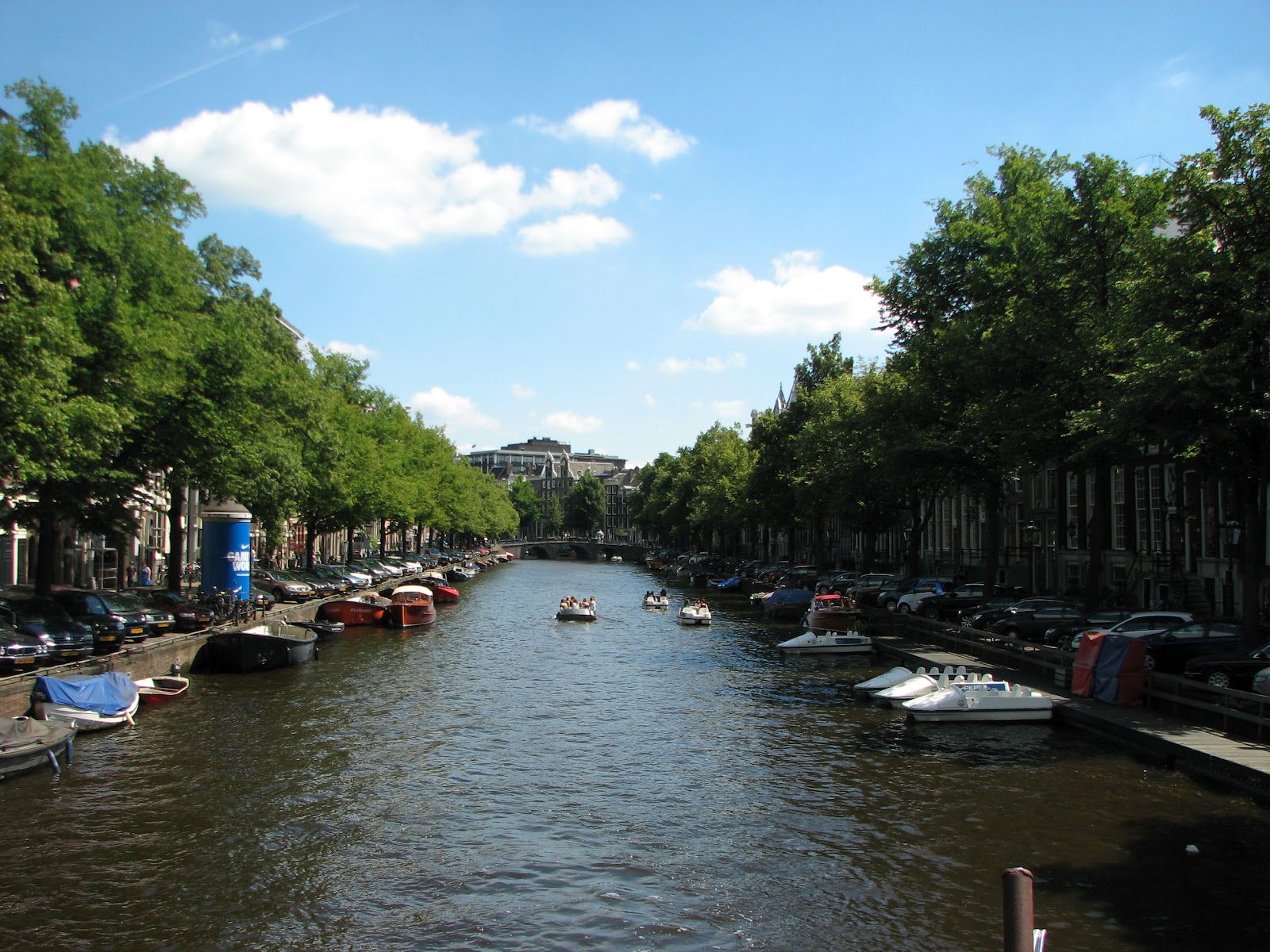
Of course, you can rent a paddle boat if you want . . . .

Speaking of busy streets . . . .

The street is shared by crowds on foot and bicycle, trams (tracks down the middle) and cars, taxis, and delivery trucks. Every man for himself.

At the Floating Gardens. There were tulips, but this is not tulip season, so not the abundance one might expect.

There are no van Gogh photos in this set, as you might have realized. Can't take photos in the museum, of course. So, I did the next best thing: took photos of sunflowers at the Gardens.

I could have indeed spent a lot more time in the cheese shops. This young woman (in the classic Dutch cap) made sure we got all the samples we wanted!

More cheese . . . and the ubiquitous speeding bicyclist.

We did avail ourselves of the sidewalk cafes as often as possible! So easy just to stop about anywhere for a cappucino. We walked by this one on the way to and from the hotel. It was much larger than most--many are just a few tables and awnings. Nevertheless, it provided a good stopping place. (Do you see any familiar folks in the crowd?)
Saturday, July 21, 2012
Pingjum and Witmarsum, Netherlands
The Netherlands—July 21
I expected flat land . . . sure enough, as far as the eye
can see. I expected water . . . canals crisscross the countryside. I expected
to see windmills; you know, the traditional ones you see in all Dutch pictures.
Saw exactly none (well, maybe or two, from a long way off.) In their stead, huge, energy-generating windmills like you see in
southern New Mexico and west Texas dotted the landscape.
And why is this country called The Netherlands and Holland
and the citizens are called Dutch? Seems in conversation with people the names
are used interchangeably. OK with me. Just curious.
We rented a car in Münster and drove the 2 ½ hours to two
little towns in the upper part of the country (called Friesland.) Everything
was green and the weather was cool. We have come to Witmarsum and the
neighboring village of Pingjum, the birthplace and burial place of Menno
Simons.
When we first arrived, we were a little hungry and needed a
bathroom. No sidewalk cafes here so we went to the Otter Bar, the first place
we found open. We had coffee and French fries with peanut sauce. It was
surprisingly wonderful! We quickly ascertained, in real time, one other
thing—Dutch is both very close to and really different from German.
These are very small villages. I think Pingjum has less than
700 residents.
But both villages were absolutely charming—neat houses and yards, flowers everywhere, thatched roofs, sheep, horses, and cows grazing in the fields. Those thatched roofs are amazing and totally a mystery!
But both villages were absolutely charming—neat houses and yards, flowers everywhere, thatched roofs, sheep, horses, and cows grazing in the fields. Those thatched roofs are amazing and totally a mystery!
We were not sure what we would find here but it seemed the
logical next place to come. We stopped at a little cafe in Pingjum and met a very friendly young couple who ran a pizzeria there. They had both grown up in Pingjum. When I asked her what there was to see in town besides the one "secret church", she said, "That's it! You've seen it all."
Menno lives on, however, in the memory of this area. His story is a fascinating one.
Menno
Simons, 1496-1561, was born in Witmarsum. His first parish as a Catholic priest
was in Pingjum. By his own confession, he lived a not so exemplary life and was
afraid to read the Bible. Over time, between doubts that arose concerning some
particulars of Catholic dogma and encounters with Lutheran thought, Simons
began to consider seriously the way of the reformers. By 1529, he considered
himself an “evangelical humanist” (but not yet a Christian.)
In 1530, Menno moved back to Witmarsum and took over a vacant
parish. The execution of an “Anabaptist” in a nearby town made a deep
impression on Menno Simons. He struggled with how anyone could be so committed
to a belief that he would die for it, especially a belief about baptism—so Menno was driven to the Bible. The result: he became convinced that he could
find no trace of infant baptism in Scripture. As a result, he experienced
doubts not only about the Catholic dogma but the about the Protestant beliefs
as well.
In 1535, his brother, Pieter, was with a group of Anabaptists that
was rounded up and executed, prompting a deep crisis of faith for Menno. In a
short time, he came to a personal faith in Christ and decided to join the
Anabaptists.
Menno soon earned a reputation among the Anabaptists.
His
travels, preaching, and writing were so influential that many Dutch and German
Anabaptists soon became known as Mennonites.
Simons reacted strongly to the disaster at Münster,
rejecting the radical chiliasm and violent means taught by Matthys, Leiden, and
the other leaders of the “Anabaptist Kingdom” rebellion. He worked diligently
to overcome the negative reactions toward, the fragmentation of, and loss of
direction experienced by the nascent movement. Nevertheless, even though he
taught pacifism, Simons and anyone who followed him were placed under a death
sentence. (In 1545, the man who had baptized Menno six years earlier was burned
at the stake for that crime.) We came across, quite accidentally, a “secret church” in Pingjum
where Mennonites had met in the early 1600s.
He spent much of the rest of his life on the
run. He and his family (wife and three children) were often separated and in
hiding. He continued to write and speak and work to bring together the
fractured brethren. His body of work is among the most comprehensive and
extensive treatments of Anabaptist thought.
Menno died in 1561 and was finally laid to rest
in Witmarsum.
Oh yes . . . we realized driving into this area that we were just a few kilometers from the North Sea. So, upon leaving Pingjum, we drove to Zurich (yep, Zurich, The Netherlands), a really tiny place right on the sea, just below the dike. A short walk takes you up to the top where the ocean spreads out before you. The dike is massive and runs for many miles along this coast. The flat land on the inland side would be under several meters of water if the dike were not there.
Oh yes . . . we realized driving into this area that we were just a few kilometers from the North Sea. So, upon leaving Pingjum, we drove to Zurich (yep, Zurich, The Netherlands), a really tiny place right on the sea, just below the dike. A short walk takes you up to the top where the ocean spreads out before you. The dike is massive and runs for many miles along this coast. The flat land on the inland side would be under several meters of water if the dike were not there.

Beautiful farm country and, like I said, flat.

First we arrived at Witmarsum, location of Simon's burial.

The whole village is covered with flowers this time of year. Every other house or so has a thatched roof.

This is, apparently, the current meeting place for the small Mennonite community.

This sign at this church indicates that this building was build a little over 50 years ago. They had met out near the Menno monument in a stone building since 1879. Before that, it was safer for them to meet secretly.

This stylized church was placed here by an organization of Mennonite communities in 2008 to represent the many varieties of Mennonites around the world who share both the history of struggle as well as an openness to their future.

It is built on the site of the old "secret church" and is next to Simon's burial place.

This plaque spells out some more about the church monument.

I took this picture because it gives the name of the group of Friesland Mennonites who are involved with this monument.

Menno Simons' burial monument with attendant curmudgeon.

The plaque at the burial site.

On to Pingjum, 3 kilometers away!

This is the "secret church" meeting house.

Look to the right . . . . (when you go to the secret church, you look both ways before entering.)

Look to the left . . . does anyone even live here?

A plaque at the site of the secret church.

"Menno's secret church" Apparently it is not so secret anymore.

Our little cafe in Pingjum. It was the only place we could see that actually had people in it. On Saturday, everyone is either in their backyard or somewhere else.

This is such beautiful, fertile farming country.

This thatched was perfectly cut and shaped on this house. How do they do that?

Climbing up the inward side of the dike.

Looking north along the dike, on the ocean side.

Mike touches the North Sea, just because when you are there, you have to.

Walking along the dike . . . from bottom to top, it is stone, asphalt and tar, dirt fill and grass at the top.

At the top of the dike. At the left is almost the whole town of Zurich.
Friday, July 20, 2012
Münster
Münster—July 20, 2012
We got on the train this morning and rode west for over 3
hours to Münster, Germany. I have looked forward to getting here. This city has
a fascinating history. It also experienced the dark chapter of the Anabaptist
story.
This is the story of the really radical Anabaptists—and not
the good kind of radical. These are the guys who give everyone else a bad name.
In fact, many scholars believe that if it had not been for the disaster in
Münster, Anabaptists might have come out of the time of persecutions in a much
better light. As it is, when most people hear the "Anabaptist", they immediately think
of the crazies who took over Münster for a short time in the mid-16th
century.
Melchior Hoffman of Strasbourg was an Anabaptist with a
strong millennial eschatology in 1530. He influenced some Dutch pastors, Jan
Matthys, Jan of Leiden, and a few others. Somehow, their belief that the
kingdom was about to arrive became convoluted to the belief that they were the
ones to usher it in and the New Zion, the “new Jerusalem”, was going to be in
Münster.
In 1534, their enthusiastic preaching (and not a little
manipulation of poor, desperate, ignorant peasants—maybe those guys back in
Basle were right) resulted in 1,000 adult baptisms. Convinced they were unstoppable,
blessed of God, and commissioned by some celestial signs, they proceeded with
their plans to conquer the rest of the world--seriously. Unlike the Anabaptists in
Switzerland and southern Germany, these guys were sure they were supposed to
take up the sword and kill all unbelievers.
They threw out the Catholic bishop, von Waldeck, purged the
city cathedral of all Catholic symbols, and demanded that the city be fully
Anabaptist. In response, von Waldeck got an army together and lay siege to the
city.
Jan Matthys was convinced he was Gideon and could defeat the
Catholics like Gideon did in the Bible. He took 30 men out of the city,
intending to destroy the enemy army. His contingent was immediately surrounded.
They were all killed, Matthys was beheaded and mutilated and his head was put on a pole for
all to see.
Inside the city, Jan of Leiden was installed as king. He
thought he was the next King David. He created a lavish court life around him
and claimed absolute power over the New Jerusalem. He claimed to receive
visions, legalized polygamy (he took 16 wives) and declared community of goods. As a Dutch saying goes, "He knew how to become a king but he did know how to rule."
The city was finally defeated in June, 1535. The next
January, Leiden and two other leaders were cruelly tortured and executed.
Their bodies were put in cages and hung on the tower of the St. Lambert’s
cathedral. The cages were left there as warnings to others.
This was a turning point for the Anabaptists. Suppression of
the movement was increased all over Germany. This event also proved to be the
impetus for the Dutch Anabaptists. Menno Simons, a former Catholic priest who had joined the Anabaptists, arose as a leader of the
movement. He attempted to get the movement back on track, hoping to reconcile disparate groups and, refuting Hoffman and the Münsterites, taught non-violence and love, not retribution, toward one’s enemies.
We really enjoyed Münster. It is a happening place. Lots of
cafes, sidewalk music, wide, cobblestoned streets. Big churches—the mega-church
movement in America has nothing on this city. Huge cathedrals seem to appear around every corner. We walked through several of them. We visited the castle, which also
happens to be the home to Westphalia University—and today there was a
graduation party. Not only that, but there was a food festival going on in the
front grounds of the castle. We also visited the city museum which had several
rooms dedicated to what they called the “Anabaptist Kingdom.” (The pamphlet we
found in one of the churches referred to the “Anabaptist reign of terror.”) I had to buy a little book in the museum shop entitled "Das Drama der "Wiedertäufer" which contains the story as told by a local historian, complete with reproductions of prints, letters, and paintings from 1534-1535.
At least they have not simply dismissed this part of their
history. Those three cages are still hanging up there on the tower
of St. Lambert’s Cathedral.

Walking through downtown Münster toward St. Lamberti's cathedral. This site was used first around the time of Charlemagne (ca. 800 AD). The parish was founded roughly around 1000. First recorded reference to the parish is about 1179.

The church is massive, darkened by age and soot, has many gargoyles and spikes--even though it is in the center of the market (three market roads meet here since antiquity), it is a glowering presence.

The market square just beside the church is filled with sidewalk cafes.

Winged altar piece dating from ca. 1500 with scenes of the Virgin Mary and the Infancy of Christ.

The interior is brighter than what one might expect. The great organ was actually hung in 1989. It is suspended freely with gallery or ground support.

The pointed-arch tracery windows. The three stained glass windows were installed after WWII (during which much of the cathedral was damaged.) They show, left to right, Resurrection, Crucifixion and Ascension.

Crucifixion grouping in St. Lamberti's, ca. 1550.

The streets radiating from the cathedral are lined with arched colonnades. Stores and cafes are found along the walk.

So, the cages are still there. Above the clock. Towering over the market place. As a warning?

This is the east side of St. Lamberti's.

The old Rat Haus . . . just inside the old city walls, in sight of that tower with the cages.

The cathedral from down the street. If you look closely, those cages are still there.

Another cathedral, St. Paul's . . . even bigger than the first one. Probably the main city church (ca. 1225). Under major restoration and construction so we did not get in.

Sausages on the street!

Down the street a little further: The Überwasserkirche, also Liebfrauen, also Marienkirche . . . it bears all these names and dates back to 1340.

For an old place, not looking too shabby.

Approaching the palace, which is now Westphalian University. (Remember, the treaty securing the Peace of Westphalia was signed in Münster. Well, sort of secured--the peace lasted a few years).

There is a food festival going on at the palace (along with a graduation ceremony going on inside. We crashed the party for few minutes.) A happening place. The name of the festival, according to the brochures we found lying around is "Münster verwöhnt"; i.e., "Discriminating (or possibly, "Spoiled") Münster". We're a long way from the cages here.

Also a line up of hybrid cars (including hybrid Mercedes and Smart Cars.)

Going back to town, the cages are still there. Do you feel like someone (something) is always looking over your shoulder? Does anyone else feel a chill in the air?

Dinner: I'll be back with descriptions . . . .

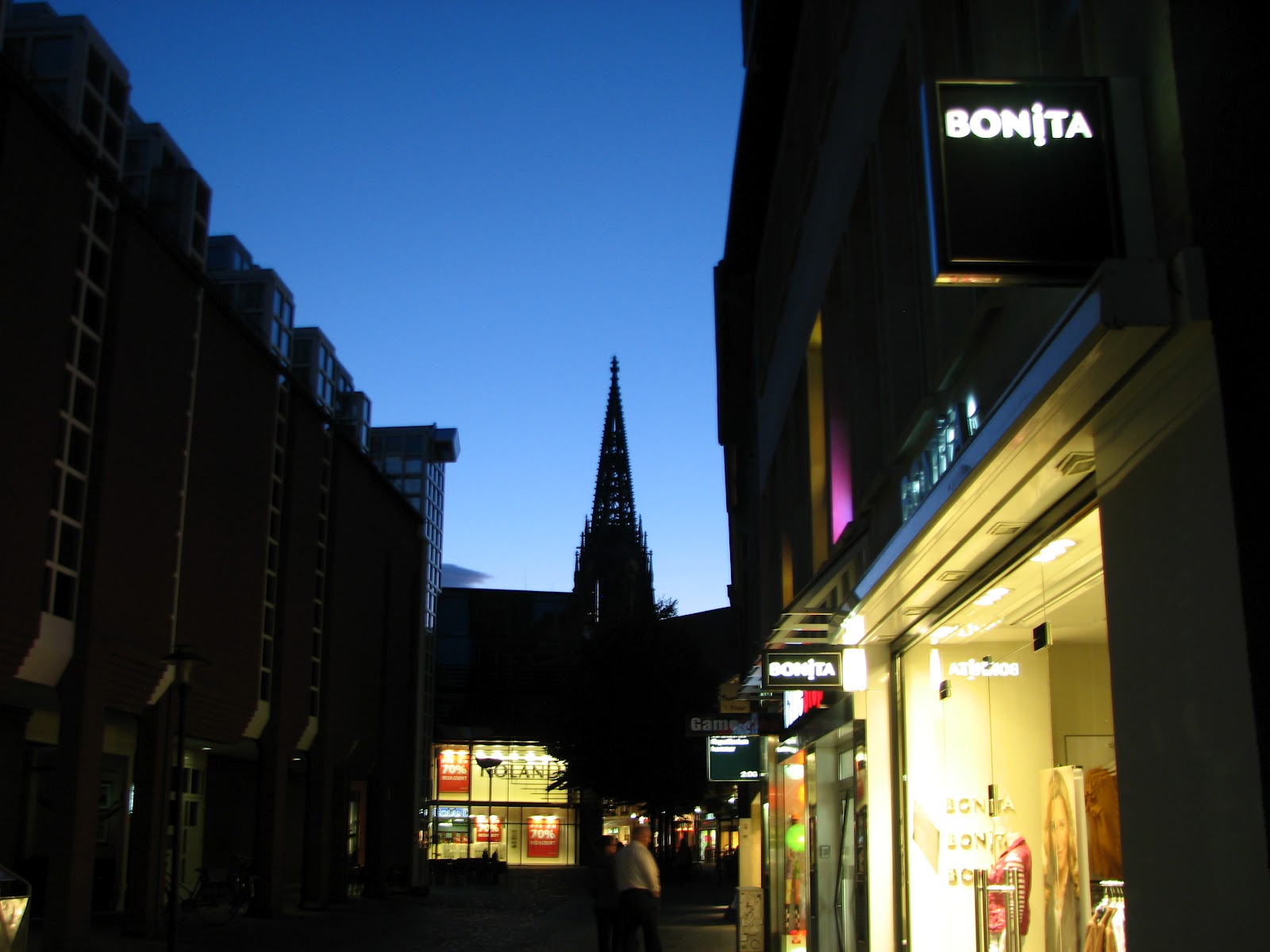
The tower keeps careful vigil over the vibrant nightlife.
Subscribe to:
Posts (Atom)